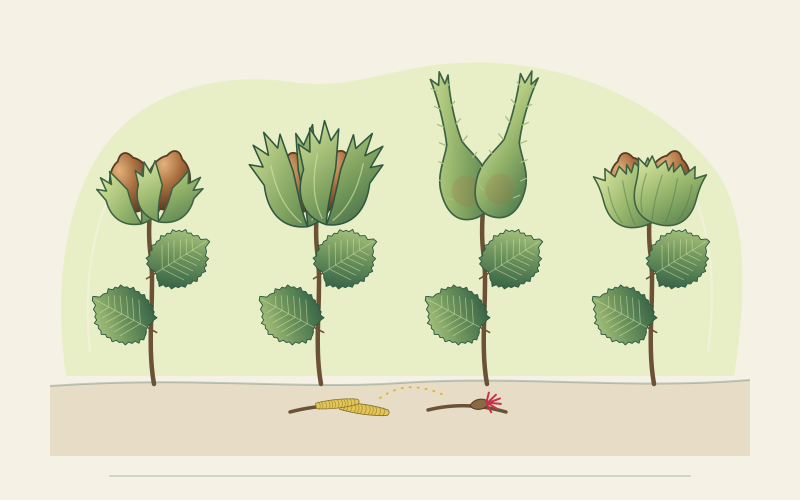
Start with species, not the word “hazelnut”
The central crop in this guide is European hazelnut, Corylus avellana. It includes many cultivated selections with relatively large, thin-shelled nuts and a shrub or small-tree habit. A nursery may call the same nuts filberts, although common usage varies by place and husk shape is not a dependable way to identify a species. Buy labelled stock and retain the cultivar record.
Local Corylus species can be better adapted where European cultivars struggle. Their presence in a landscape does not make them interchangeable pollen sources or equivalent food crops. Nuts may be smaller, shells thicker and husks more persistent; mature dimensions and disease responses can differ substantially. Ask for species or hybrid parentage, propagation method and local production experience.
| Identity | Why consider it | Selection caution |
|---|---|---|
| C. avellana | Large-fruited European cultivars and established kernel-quality selection | Early flowering, exact compatibility and eastern filbert blight response |
| C. americana | Native North American shrub with cold hardiness and local ecological value | Smaller nuts; use genetically distinct seedlings or proven compatible selections |
| C. cornuta | Beaked hazelnut adapted to suitable northern North American sites | Elongated husk and different nut form; local availability and production experience vary |
| C. heterophylla, C. mandshurica | Locally relevant Asian hazel species and breeding parents | Do not substitute European cultivar tables for local species or hybrid advice |
| Named or seed-grown hybrids | Combinations selected for hardiness, disease response or nut production | “Hybrid” is not one uniform type; sibling seedlings can vary in every trait |
In the Andean and East African highlands, Corylus is not native and temperate chilling cannot be assumed. A successful shrub in a botanic collection is not evidence of reliable cropping. Elsewhere, native or locally tested material may offer a more realistic route than forcing C. avellana into an unsuitable site.
Compatibility and flowering overlap are separate tests
Hazelnuts are monoecious, carrying male catkins and female flowers on the same shrub, but they are also self-incompatible. A catkin’s own pollen generally cannot fertilise the female flowers on that plant. In addition, Oregon State explains that some combinations of different cultivars are cross-incompatible because of their incompatibility alleles. “Two varieties” therefore needs more precision.
Test one: can the pollen work? Use a documented compatible pollinizer for the recipient cultivar. A table that lists a pollen source for one cultivar does not necessarily establish that every pairing works equally in both directions. The female parent and pollen parent have specific genetics; use current reciprocal or orchard-design guidance where it matters.
Test two: is pollen present when stigmas are receptive? Male and female phases can differ within one cultivar and between cultivars. Cold or warm weather shifts their timing. Pollen released too early or too late is of little use even when the genetics are compatible. Observe actual catkins and red female styles over the season instead of relying only on broad labels such as “early”.
Test three: is the source close enough? Hazel pollen moves on wind and becomes more dilute with distance. Oregon State notes reduced set when recipients are more than about 50 feet (15 m) from pollinizers. For a small garden, plant the recommended partner nearby. Larger orchards commonly distribute several pollinizer cultivars with early, middle and late pollen shed to cover a long female-flowering period.
Read named pairs as starting evidence, not a shopping list
Utah State’s home-orchard publication provides the following examples for European hazelnut. They are useful because they name both the crop cultivar and possible pollen source. They do not override newer regional trials, disease outbreaks, quarantine rules or supplier corrections.
| Crop cultivar | Listed possible pollinizer | Important context |
|---|---|---|
| ‘Jefferson’ | ‘Eta’ or ‘Theta’ | ‘Jefferson’ has eastern filbert blight resistance; pollinizers differ in flowering time |
| ‘Yamhill’ | ‘Santiam’ or ‘Gamma’ | ‘Yamhill’ is relatively early ripening and resistant; local scale is smaller than ‘Barcelona’ |
| ‘Santiam’ | ‘Gamma’ or ‘Yamhill’ | Resistance does not remove the need for compatible overlapping pollen |
| ‘Butler’ | ‘Ennis’ | Check disease suitability before using older susceptible cultivars |
| ‘Ennis’ | ‘Butler’ | ‘Ennis’ is very susceptible to eastern filbert blight |
| ‘Barcelona’ | ‘Casina’ | ‘Barcelona’ is susceptible and is being used less where blight is a constraint |
| ‘Casina’ | ‘Barcelona’ or ‘White Aveline’ | Verify which option best covers the local flowering period |
‘Eta’, ‘Theta’ and ‘Gamma’ have been used as pollinizer selections, but that functional description does not make any of them universally compatible with every hazelnut. Likewise, a pollinizer can produce edible nuts; its orchard role does not make its own crop irrelevant. Its female flowers also need suitable pollen, so a whole planting must be designed rather than adding one isolated “male tree”. Hazels do not have male-only and female-only individuals.
For seed-grown American or beaked hazelnuts, Utah State recommends two or three genetically distinct plants of the same species. Seed-grown siblings are not identical clones, but their nut size, yield and flowering can vary. Buying two vegetatively propagated plants with the same cultivar name recreates the self-pollen problem rather than solving it.
Let winter, flowers and disease narrow the list
Survival is not flower survival
Dormant European hazel wood can survive cold that would damage a later growth stage. Early flowering creates a different vulnerability: red stigmas and pollen release can occur during winter weather, and unseasonable cold can compromise a crop even when the shrub remains alive. Utah State notes that American, beaked and some hybrid types can be more consistent in cold districts, yet their flowers can still be injured by temperature fluctuations.
Match winter chilling and frost to the exact site. At warm or low-chill margins, dormancy and flowering may be irregular; at cold margins, flower damage can recur. Altitude and air drainage matter as much as a regional average. A sheltered wall may reduce wind but create a frost trap or excessively warm microclimate, so observe the site before assuming it is an improvement.
Disease resistance is specific
Eastern filbert blight, caused by Anisogramma anomala, has transformed cultivar choice in affected North American districts. ‘Jefferson’, ‘Yamhill’, ‘Santiam’ and selected pollinizers were bred with resistance or immunity in this context, while ‘Barcelona’ and ‘Ennis’ are important susceptible examples. Do not plant a famous older cultivar merely because a pair appears in a table.
Resistance is not universal immunity to every hazel disease, and local pathogen populations or regulations can change recommendations. Buy healthy stock from a reputable source, inspect stems and obtain a diagnosis for cankers. The growing guide covers pruning and sanitation, but cultivar selection remains the first line of defence where blight is established.
Choose nuts for the actual harvest and kitchen
Commercial selection often balances kernel percentage, shell thickness, nut calibre, ease of husking, blanching, flavour and suitability for mechanical harvest. A home grower may care more about reliable ripening, manageable height and whether nuts fall free of their husks. Large nuts are not useful if a shrub flowers reliably but never receives compatible pollen.
‘Barcelona’ illustrates a traditional large-crop cultivar; ‘Yamhill’ a smaller resistant selection with relatively early ripening; ‘Jefferson’ a resistant, productive selection with high-quality kernels. Mediterranean cultivars such as ‘Tonda di Giffoni’ illustrate regional selection for kernel quality and processing, not a recommendation to plant them without local pollinizer and climate evidence. Always ask “selected where, for which system, and with what pollen?”
Native species and seedlings deserve a different evaluation. Compare several plants for filled-kernel proportion, ease of cracking, husk retention, yield regularity and flowering before propagating a favourite. Keep harvests separate by plant during evaluation. A flavourful small nut can be worthwhile for local food and habitat even when it does not resemble a commercial European kernel.
Turn the catalogue into a planting plan
Record the complete identity
Write down species or known hybrid parentage, cultivar, rootstock if grafted, and whether plants are clonal or seed-grown. Avoid stock sold only as “hazelnut tree”.
Ask for the pollen plan
Request named compatible pollen sources and their relative pollen-shed periods. Confirm how close they should be planted and whether an additional timing group is needed.
Check local disease and winter evidence
Use current extension advice and nearby grower experience. A cultivar description from another country cannot establish resistance, flowering safety or chilling success on your site.
Fit mature form and harvest to the space
Allow room for the shrub or train the tree form deliberately. Plan clean ground collection, wildlife pressure and a covered low-temperature drying setup before the first crop arrives.
Keep records after planting
Label both members of the pair, map their positions and note catkin release, female receptivity, disease and nut set. Those observations are more useful than a generic bloom month when refining the planting.
Sources and variety references
- Oregon State University Extension: Growing Hazelnuts in the Pacific Northwest—Pollination and Nut Development
- Utah State University Extension: Hazelnuts in the Home Orchard—species and possible pollinizers
- Oregon State University Extension: Growing Tree Fruits and Nuts at Home
- Ontario Ministry of Agriculture, Food and Rural Affairs: Guide to Hazelnut Production in Ontario