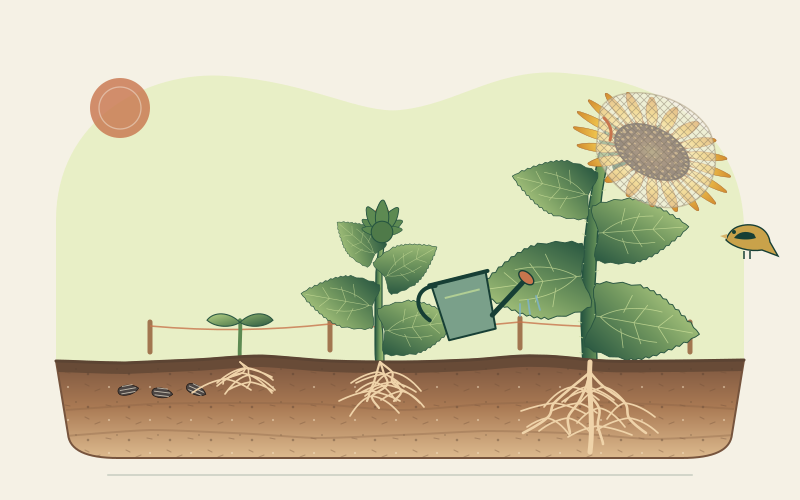
Decide what the plant is for
Helianthus annuus is a frost-tender annual, not the perennial Jerusalem artichoke or one of the perennial ornamental Helianthus species. Its apparent flower is a composite head: showy outer ray florets surround many disk florets. Each fertilised disk floret can produce a dry fruit, called an achene, with a hull around the edible kernel. Gardeners normally call the whole fruit a seed.
Oilseed cultivars are selected for oil content and usually have smaller black, relatively thin-hulled seed. Confectionery types produce larger, often striped seed for in-shell roasting or hulling. Ornamental cultivars are selected for branching, plant size, petal colour or cut-flower quality; pollenless forms are useful for clean bouquets but cannot set seed without pollen from a compatible plant. See the type guide before sowing.
Rooted uses 80–140 days from direct sowing to mature seed. Many cultivars finish around 90–120 days, but cool conditions and late planting extend development. Cut-flower harvest can be earlier and says nothing about seed maturity. Even a physiologically mature head often needs additional drying before shelling and storage.
Sow directly and keep the stand balanced
Wait for frost-free, warming soil
Direct-sow after local frost danger has passed. NDSU cites soil near 10°C (50°F) for germination; warmer conditions usually produce faster, more even establishment. A sunny afternoon does not warm a cold saturated seedbed. In short seasons choose an early cultivar and, if using a protected start for ornamentals, transplant promptly without damaging the developing taproot. Food seed crops still need their full warm season outdoors.
Give roots drainage and full sun
Choose a site with at least several hours of direct sun, preferably full sun, and deep free-draining soil. Sunflower can use water from a deep root zone, but it grows poorly in prolonged waterlogging. Prepare only a workable seedbed, preserving soil structure. Follow a soil test and local fertiliser recommendation; very high nitrogen can promote lodging, delay maturity or increase disease risk rather than guaranteeing a larger food harvest.
Use packet depth and type-specific spacing
A common starting sowing depth is roughly 2–4 cm. Compact branching ornamentals, giant single-headed plants and field oilseed cultivars need different final stands, so use the supplier’s spacing rather than one universal grid. Thin crowded seedlings. Plants can compensate for wider spacing with larger heads, while very dense stands tend to produce smaller heads and compete more strongly for water.
Weed early and support exposed stems
Control weeds while sunflower seedlings are small; early competition matters. Hoe carefully around roots or use an appropriate mulch once the soil is warm, keeping material away from the stem. Tall single-stem cultivars in wind may need a firm stake installed early and a loose tie. Do not cinch the expanding stem, and remember that staking cannot correct a badly lodged root system.
Water the stages that build seed
Keep the seed zone moist, not saturated, until emergence. Afterwards water according to soil moisture and weather. Establishment, flowering and seed fill are especially important; severe stress can reduce pollen performance, fertilisation and kernel fill. Water at the root zone, allowing excess to drain. Deep roots improve access to stored moisture but do not make an irrigated garden sunflower independent of water.
Let seed flowers receive pollen
Many sunflowers benefit from cross-pollination by bees and other insects, even where some self-pollination is possible. Avoid unnecessary insecticide use, especially during bloom. If local pest control is justified, identify the pest and follow the current legal label and pollinator precautions. Do not bag a head for bird protection before pollination unless you have a deliberate, informed hand-pollination plan.
Prevent disease and wildlife losses locally
Buy sound seed and use locally adapted disease resistance where available. Rotate with unrelated crops according to regional advice, avoid working wet foliage and keep the root zone drained. Rust, mildew, Sclerotinia rots and other head diseases vary by climate; a name seen online is not a diagnosis. Remove or dispose of affected material only as local plant-health guidance recommends, and seek diagnosis for spreading or unexplained damage.
Birds often begin feeding before a grower considers the head ready. Decide which heads, if any, to leave for wildlife. For food heads, use a breathable paper or cloth bag, cheesecloth or suitable netting once flowering and pollination are complete. Support netting so it cannot entangle birds, check it frequently, and avoid plastic bags or damp covers that trap condensation. Rodents can attack cut heads too, so the drying area must be protected as well as ventilated.
Harvest maturity, then manage moisture
| Harvest | Ready when | Next step |
|---|---|---|
| Cut flowers | Cultivar-specific bud or early-opening stage | Use clean tools and water; do not expect pollenless blooms to yield seed alone |
| Food seed | Back yellow to brown, bracts drying, filled firm seed | Protect, cut and finish drying with airflow |
| Seed for sowing | Fully mature viable seed from a suitable cultivar | Keep cool and dry; avoid high drying temperatures |
| Oil | Clean, sound, appropriately dry oilseed | Use a suitable food-safe press and handle fresh oil as perishable |
For seed, inspect the back of the head and a sample of fruits rather than waiting for every ray petal to fall. Backs commonly turn yellow and then brown while bracts dry; filled seed becomes firm and develops its mature colour. Stay-green cultivars may not show every textbook signal. Cut before prolonged rain, severe frost or birds destroy quality, leaving enough stem for hanging or handling.
Dry heads in a single layer or hang them with space between in a clean, shaded, ventilated and wildlife-protected place. The National Center for Home Food Preservation also describes drying seed in the sun or a dehydrator at about 38°C (100°F), noting that higher temperatures affect flavour. Rub or shell dry seed over a clean surface, remove debris, and do not seal it while warm or damp. Commercial guidance distinguishes oilseed and confectionery storage moisture; home growers without a moisture meter should use current local advice and favour small, cool, well-inspected stores.
Store thoroughly dry sound seed in labelled food-safe airtight containers in a cool dark place. Hulled kernels have more exposed oil and generally lose quality faster; refrigeration or freezing in moisture-proof packaging extends quality. Inspect for condensation, insects, mustiness and rancid odours. Discard mouldy or doubtful food or feed seed. Drying, roasting or pressing does not reliably make a spoiled lot safe.
Treat home oil pressing as a small-batch craft
A flower head contains less oil than its visual bulk suggests. Oilseed also needs cleaning, usually dehulling or a press designed for the chosen seed, controlled feeding and collection of both oil and press cake. A few ornamental or confectionery heads are normally better used as whole food or saved seed than as an oil project. Actual yield depends on cultivar, oil content, moisture, hull, press and operator; do not calculate a bottle from head diameter.
Use only equipment intended for food and follow its cleaning and operating instructions. Freshly pressed oil contains fine solids and may contain moisture. Let particles settle in a clean covered vessel, decant carefully and use a suitable food-grade filter without introducing water. Bottle in a clean dry opaque or dark container, label the date, keep cool and dark, and make small batches for prompt use. Refrigerate fresh unrefined oil unless a reliable processor gives different tested guidance. Cloudiness from cold is not itself proof of spoilage, but rancid odour or flavour is a reason to discard.
Home pressing is not industrial refining, degumming, bleaching or deodorising. It does not create a standardised shelf life or smoke point, and the press cake remains a moist protein-rich material that spoils quickly unless handled appropriately. Do not use solvent extraction or improvised heating equipment. If safe cleaning, drying and short-term storage are not practical, keep the kernels whole and leave oil manufacture to a reputable processor.