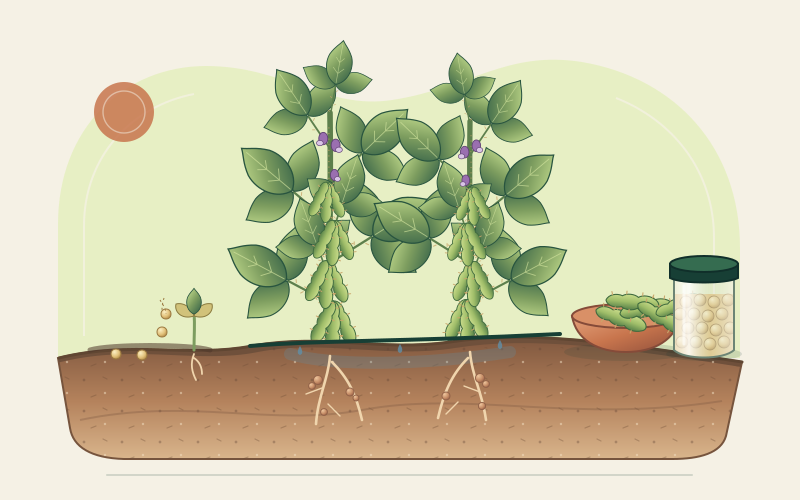
Know the annual plant and fit the season
Soybean, Glycine max, is a warm-season annual legume with trifoliate leaves and usually hairy pods. It is the same species whether grown as vegetable soybean for edamame or left to produce mature dry beans. Edamame cultivars are selected for large green seeds, flavour, texture and pod characteristics; dry types are selected for mature seed yield and quality. The variety guide explains why one packet cannot be judged by seed colour alone.
Rooted uses about 70–100 days from direct sowing to first green edamame harvest and 90–150 days to mature dry beans as broad planning ranges. These are not guarantees. Cultivar, temperature, planting date and latitude change development, and some regional trials take longer than a catalogue’s nominal days. Dry-bean harvest is a separate goal, not simply an edamame harvest forgotten for a week.
Soybean flowering responds to photoperiod—the length of day and night—as well as temperature. Many cultivars are short-day plants whose flowering accelerates as nights lengthen, but sensitivity differs. Maturity groups help match cultivars to latitude and growing season. A later group moved too far north may keep growing leaves and fail to mature before frost; an unsuitable early group moved elsewhere may flower too soon and remain small.
Direct sow and build an even, warm-season stand
Wait for frost-free, warming soil
Choose a sunny, well-drained bed and sow after local frost danger has passed. Soybean seed can rot or emerge poorly in cold, saturated soil. A useful general guide is soil warming toward at least 13–16°C with a settled forecast, but regional recommendations may call for warmer conditions. Do not trade a suitable seedbed for an early date.
Place seed directly where it will grow
As a garden starting point, sow roughly 2.5–4 cm deep and 5–10 cm apart, with enough room between rows to weed and inspect. Seed size, soil texture and local practice affect depth and spacing, so follow the packet and local extension advice. Sow into moisture; avoid a crusted surface or waterlogged hollows that obstruct emergence.
Keep the bed open, not overfed
Bush soybeans do not need a trellis. Control weeds early without damaging shallow roots, and avoid compaction. Use a soil test to guide pH and nutrient amendments. Heavy nitrogen fertiliser is unnecessary in many garden settings and can favour leaves over the intended crop; nodulation also does not excuse poor drainage or a badly matched cultivar.
Use only soybean-compatible inoculant when advised
Soybeans associate with Bradyrhizobium japonicum. On ground new to soybean, local guidance may recommend a fresh labelled soybean inoculant so effective root nodules can form. Common-bean or pea inoculant is not a substitute. Follow storage and application instructions, and do not assume every pink nodule guarantees a particular yield.
Maintain moisture through flowering and filling
Check moisture below the surface and water at soil level when needed. Establishment, flowering and seed filling are particularly important; drought adaptation elsewhere in the plant’s life does not make filling pods independent of water. Avoid chronic saturation and routine foliage wetting. As dry beans approach maturity, do not encourage fresh growth with unnecessary late feeding or irrigation.
Use maturity groups as local information, not global labels
North American maturity groups run from extremely early groups such as 000 toward later groups, with regional conventions and decimal ratings adding detail. Other countries may use different classification systems. The useful question is not “What is the best group?” but “Which named cultivars have matured reliably at this latitude, elevation and sowing date?” A number printed without that context has limited value.
In northwestern Europe and northern North America, begin with the earliest locally recommended cultivars and accept that dry seed may be uncertain in a cool, wet autumn. Mediterranean lowlands have warmth but need water through flowering and filling. In Andean and East African settings, altitude, frost and seasonal rain narrow the suitable sites; imported temperate maturity labels may not predict performance near the equator. Temperate East Asian gardens also need locally adapted maturity and drainage during monsoon rain.
For edamame, a small succession of locally suitable sowings can spread harvest, but later sowings may develop differently as day length changes. For a dry crop, late sowing can put maturity into frost or persistent rain. Record sowing date, first flowers, green harvest and mature harvest so next year’s choice rests on your own observations as well as regional trials.
Read the pods and handle each harvest differently
| Intended crop | Ready when | Handle next |
|---|---|---|
| Edamame | Pods are bright green and plump; filled seeds nearly touch inside | Pick or cut plants, chill promptly, cook thoroughly; blanch before freezing |
| Dry beans | Pods are mature brown and dry; seeds are hard and mature | Harvest before sustained wet weather, thresh, dry fully and store sealed |
Edamame has a short quality window
Open a sample pod rather than judging plant height. At the preferred stage the beans fill the pod and nearly touch, while the pod remains bright green. Yellowing indicates that the best succulent vegetable stage is passing and the beans are becoming starchy. Many plants in a planting reach this stage together, and the prime window can be only a few days in warm weather. Inspect daily as harvest approaches.
Pick individual pods or cut whole plants when most pods are ready. The pod itself is fibrous and is not the edible portion. Refrigerate the harvest promptly in clean conditions and cook soon. For freezing, Utah State University Extension describes washing mature green pods, blanching them for 3 minutes in boiling water, cooling and drying them, and packing in freezer bags. Blanching prepares pods for freezing; it is not the final cooking step. Cook frozen edamame thoroughly according to a reliable recipe before eating.
Dry beans need maturity followed by drying
Leave the storage crop on the plant until pods are brown and dry and the seeds are hard. Harvest before prolonged rain promotes mould, sprouting or staining, and before brittle pods shatter. If weather interrupts field drying, move cut or lifted plants under a roof with strong ventilation and spread them thinly; do not heap damp plants in a closed container.
Thresh brittle pods gently, winnow away chaff and remove stones, damaged seed and debris. Spread the beans in a thin layer until thoroughly dry for the intended storage period; a sealed jar cannot make damp seed safe. Store in clean airtight containers in a cool, dark, dry place, labelled with cultivar and year. Inspect for condensation, insects and mould, and discard doubtful lots rather than trying to cook away visible spoilage.
Drying, soaking and blanching are not final cooking
Do not eat raw green soybeans from the pod or chew raw dry beans to test them. Soybeans contain heat-sensitive compounds including trypsin inhibitors, and appropriate heat treatment is an established part of making soybean foods suitable to eat. Sort and rinse food-grade dry beans, discard mouldy or doubtful seed, and soak only if your chosen method uses soaking. Drain, rinse and cook in fresh water until tender throughout, following a reliable recipe or pressure-cooker instructions and its safety limits.
Boil fresh edamame pods or shelled beans according to a sound recipe—Utah State University gives about 5 minutes for fresh whole pods—then serve the beans, not the pods. Cooking time varies with seed maturity, size, age and equipment, so use a tested method and check doneness. Refrigerate leftovers promptly in clean covered containers. Planting seed may be treated or otherwise unsuitable for food; grow and keep a clearly identified food-grade supply.
See the kitchen guide for the distinction between green edamame and mature cooked-bean nutrient values. Neither form should be seasoned or processed under the assumption that the other’s water content and cooking time are the same.