Know which hazel you are planting
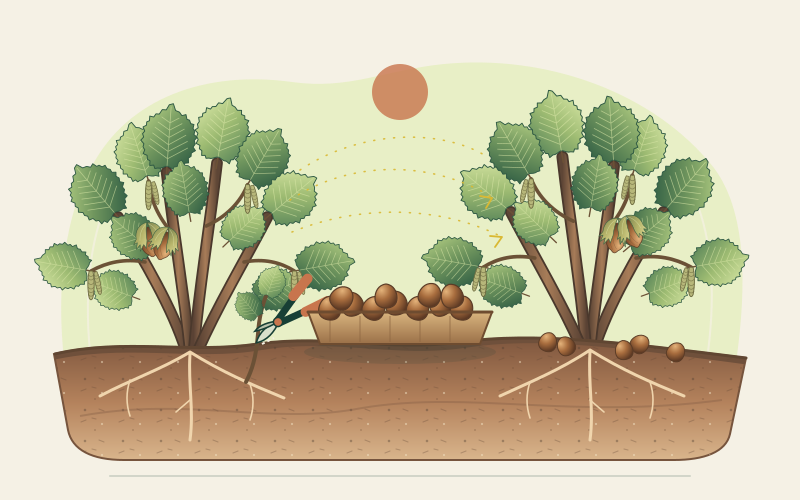
This guide centres on European hazelnut, Corylus avellana, a deciduous shrub or small tree in the birch family. It naturally produces several woody stems and can be maintained as a shrub or trained with a clear trunk. Its nuts develop inside leafy husks, while the much smaller female flowers appear as red tufts and the male flowers form hanging catkins.
“Hazelnut” is not one universally adapted plant. North American C. americana and C. cornuta, Asian species such as C. heterophylla, and complex hybrids can outperform European cultivars in particular climates. They differ in nut size, husk form, mature dimensions, winter response, disease resistance and pollination. Use the complete nursery identification, and do not assume advice for a large-fruited European orchard cultivar transfers to a seed-grown native hedge.
A first crop commonly takes about three to five years after planting a young selected shrub. Utah State reports initial production at three to four years and full production at seven to eight years; Oregon State gives a longer five-to-six-year bearing estimate for its home-orchard conditions. These are establishment ranges, not guarantees. Weak stock, drought, winter injury, early-flower frost, disease, heavy pruning or incompatible pollen can delay cropping indefinitely.
Plant for cross-pollination, not just two shrubs
Hazelnuts are monoecious: separate male and female flowers occur on the same plant. That does not make them self-fertile. Oregon State describes European hazelnuts as self-incompatible, and some pairs of cultivars are cross-incompatible as well. Pollen travels by wind rather than relying on bees, and it must be genetically compatible with the receiving flower.
Timing is the second requirement. Catkins release pollen during winter or very early spring, while female stigmas are receptive over a cultivar- and weather-specific period. If pollen shed finishes before the red styles emerge, even a genetically compatible cultivar may set poorly. Two plants of one named clone provide no new compatible pollen, and an unnamed neighbouring hazel is not a reliable substitute for a documented plan.
For a small garden, buy a main cultivar and a pollinizer listed as compatible by a current extension table or knowledgeable local supplier. Documented examples include ‘Jefferson’ with ‘Eta’ or ‘Theta’, ‘Butler’ with ‘Ennis’, and ‘Barcelona’ with ‘Casina’. These names are illustrations, not universal recommendations: ‘Barcelona’ and ‘Ennis’ have serious eastern filbert blight susceptibility where that disease occurs. The variety and pairing guide explains how to read these combinations.
Place the pollinizer close enough for a useful local pollen concentration. Oregon State notes evidence of reduced nut set when recipient trees are more than about 50 feet (15 m) from a pollinizer and recommends several flowering times in larger orchards. A home grower can record pollen release and female receptivity each winter, then add a suitable early, middle or late pollinizer if observation shows a gap.
Give roots drainage and early flowers shelter
Choose full sun or very light shade, moving air and a site sheltered from destructive wind. Hazelnuts grow in a range of soils if drainage is good, but deep moisture-retentive loam supports the most reliable establishment. Avoid soil that stays saturated, shallow compacted ground and low pockets where cold air collects. Dormant hardiness does not protect exposed flowers from every late frost.
Test soil before making major pH or fertiliser changes. Clear perennial weeds over a broad area and plan the mature spread, not the size of the nursery pot. Utah State suggests roughly 15–20 feet (4.5–6 m) between orchard plants; a deliberately renewed shrub or hedge may use a locally proven different spacing. Leave access on all sides for pruning, inspection and collection of fallen nuts.
Plant at the right local window
Use healthy bare-root stock during dormancy or container stock in the locally recommended spring or dormant window. Avoid frozen or waterlogged soil. Keep bare roots covered and moist until planting, and never leave them exposed while digging.
Set the root collar correctly
Make a hole wide enough for roots to spread without bending and deep enough to keep the original root collar at the appropriate level. Backfill with the excavated soil, firm gently to remove large air pockets and water thoroughly. Do not bury the stem or add a concentrated fertiliser plug.
Mulch and water through establishment
Maintain a weed-free zone and apply a modest organic mulch layer over the root zone, keeping it away from stems. Water deeply when the soil begins to dry rather than on a fixed daily schedule. Young plants need supplemental water for at least the first two years in dry weather, but constant saturation encourages root problems.
Decide whether suckers belong to the design
A hazel’s basal shoots are normal growth, not automatically a defect. The pruning decision follows the intended form. For a multi-stem shrub, retain a mixture of vigorous younger and mature stems and renew the plant gradually. Utah State suggests removing about 15–20% of old growth near the base each year. This maintains useful new wood without turning renewal into a severe all-over cut.
For a small tree, select three to five strong scaffold branches during establishment and remove suckers from around the base every year. Oregon State notes that without this work a hazelnut returns to bush form. Cut unwanted shoots close to their origin with clean, sharp tools rather than repeatedly mowing or tearing them, which leaves ragged regrowth. Suckers below a graft, if present, are rootstock growth and should not replace the selected cultivar.
Prune during the locally appropriate dormant window, accounting for remaining winter cold and the early flowering season. Remove dead, damaged and poorly placed wood, keep the centre reachable and avoid stripping all young shoots. Annual moderate work is easier on the plant than occasional drastic reduction. Keep a simple sketch so the original scaffolds and pollinizer identities are not lost.
Protect nut filling and diagnose problems locally
Healthy foliage and adequate root-zone moisture matter after pollination. Oregon State’s unusual flowering timeline explains why: pollination can occur in winter, but fertilisation and rapid kernel growth follow months later. Midsummer drought, deep shade and overcrowded old wood can contribute to poorly filled nuts. Irrigate established plants during severe dry periods according to soil and local water guidance, without keeping the root zone wet.
Avoid routine high-nitrogen feeding. Use soil or leaf analysis and local recommendations where production problems justify it; more fertiliser does not compensate for missing compatible pollen. Keep mulch off the stems and manage grass competition, particularly while young roots are spreading.
Eastern filbert blight is a major constraint on susceptible European cultivars in affected regions. Resistant cultivars are the strongest foundation, not a promise that no disease will occur. Inspect stems for cankers and dieback, and obtain a local diagnosis before cutting or treating. Insects, mildew and root disorders differ by district. Any pesticide must be legally available, justified by identification, and used exactly according to a label covering hazelnuts, the target problem and the pre-harvest interval.
Squirrels and jays can remove nuts before a casual grower notices maturity. Frequent collection is often more practical than relying on one final harvest day. Netting or exclusion must be checked so wildlife cannot become trapped, and it never substitutes for picking up sound nuts promptly.
Harvest maturity, then remove moisture deliberately
European hazelnuts commonly mature as husks dry and open and nuts fall, often from late summer into autumn depending on cultivar and place. Seed-grown plants may hold nuts after husks brown, so use local observation rather than forcing green husks apart. Gather from clean ground several times a week. Remove loose damp husks where practical, and sort out cracked, mouldy, insect-damaged or otherwise doubtful nuts.
Use controlled low heat and moving air
Fresh nuts are not storage-stable merely because their shells feel hard. Utah State recommends drying at 95–105°F (35–40.5°C) for 72–96 hours and warns that temperatures above 110°F (43°C) can harm flavour. Ontario guidance likewise calls for drying within about 24 hours and uses roughly 32–38°C for commercial handling. Spread in-shell nuts in shallow layers on clean food-safe trays, maintain airflow and follow the equipment’s safe operating instructions.
The published time is a planning range, not proof of dryness. Nut size, initial moisture, tray load, air speed and ambient humidity change the result. Do not use an oven that cannot hold the stated low temperature, and do not turn up the heat to compensate for a damp climate. Where available, local moisture testing gives a better endpoint than appearance. Without it, work with an experienced local grower or extension service and err on the side of continued controlled drying and shorter storage.
Cool, inspect and store airtight
Let nuts cool before packing so warm air does not create condensation in the container. Inspect representative cracked nuts and the whole batch for moisture, mould, insects and off odours. Pack thoroughly dry sound nuts in clean, labelled airtight containers and store cool and dark. Refrigeration or freezing in suitable packaging slows quality loss, especially after shelling, but neither rescues wet or mouldy nuts.
Hazelnuts’ high oil content makes rancidity a storage concern as well as mould. Discard nuts that are mouldy, rancid, fermented or of doubtful storage history; do not wash off mould and return them to the batch. Roasting is a separate preparation step, not a substitute for post-harvest drying. The nutrition guide explains why raw, roasted and spread values cannot be swapped.
Sources and further guidance
- Oregon State University Extension: Growing Hazelnuts in the Pacific Northwest—Pollination and Nut Development
- Utah State University Extension: Hazelnuts in the Home Orchard
- Oregon State University Extension: Growing Tree Fruits and Nuts at Home
- Ontario Ministry of Agriculture, Food and Rural Affairs: Guide to Hazelnut Production in Ontario
- Oregon State University Extension: Harvesting, Handling, and Storing Nuts from the Home Orchard