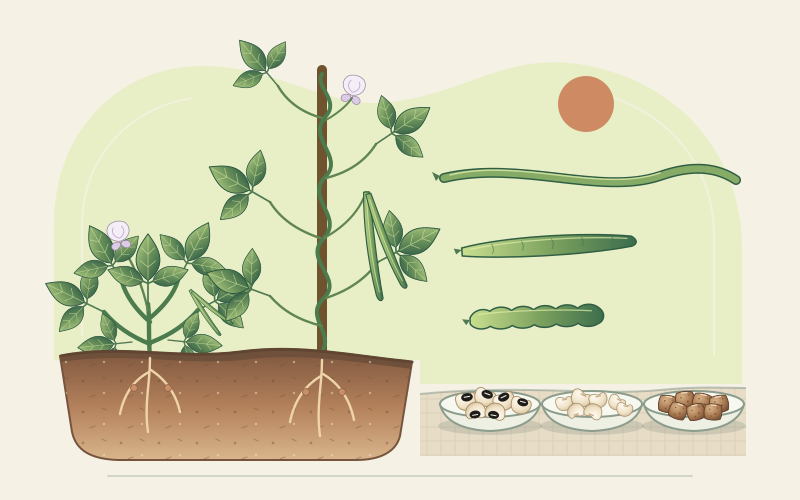
Many names, one diverse species
Cowpea, black-eyed pea, southern pea, field pea, crowder pea and cream pea are among the names applied to Vigna unguiculata. The familiar black-eyed pea is a pale seed with a dark hilum—the scar where the seed attached inside the pod—but not every cowpea has that pattern. Seeds may also be cream, brown, red or mottled, with different sizes and crowding within the pod.
The species also includes yardlong or asparagus-bean types, usually described as the Sesquipedalis group. These vigorous climbers are selected for very long, tender immature pods eaten as a vegetable. Their kitchen use and harvest cues differ from a bush blackeye crop grown for shelling or dry seed, even though they belong to the same species.
Names vary by market and region, so use the botanical identity and the supplier’s description rather than assuming that “field pea” always means cowpea. In other places it may refer to Pisum sativum, a genuinely different crop with a cool-season habit.
Read plant habit before planning the bed
| Habit | Typical garden behaviour | Planning consequence |
|---|---|---|
| Bush | Compact, self-supporting plants; flowering may be relatively concentrated | Useful for a small bed and a more concentrated harvest; no routine trellis |
| Semi-vining | Longer, spreading branches between compact and fully climbing forms | Allow extra width; light support may keep pods off the soil if the supplier recommends it |
| Climbing | Twining stems make substantial upward growth and often a prolonged picking season | Install strong early support, allow harvest access and anchor against wind |
Habit does not prove days to maturity. An early bush can be a good dry-seed choice in a short season, while a climbing yardlong cultivar is chosen for repeated fresh-pod picking. Some climbing cowpeas can also mature seed. Read the actual packet for height, spread, support, days to the intended harvest and local suitability.
Plant structure affects water and pest inspection too. Dense vines need enough spacing and airflow for local humid conditions, while an open bush row is easier to cultivate. No habit escapes frost, establishment stress or the need for pod-filling moisture.
Use seed and pod classes as kitchen clues
Blackeye: a recognisable hilum, not a performance guarantee
Blackeye types have pale cream or white seed with a dark hilum. They are widely used as fresh shelled or mature dry cowpeas. The dark “eye” does not indicate a particular maturity, growth habit, drought response or nutritional superiority. Those traits come from the cultivar and its growing conditions.
Cream and crowder: seed and pod arrangements
Cream types generally lack the conspicuous dark eye and produce lighter-coloured cooked seed. Crowder types are named for seeds closely crowded in the pod, often becoming somewhat angular at contact points. Both categories include varied cultivars and may overlap with local market names. Choose by eating quality and verified local performance rather than treating either label as a precise botanical subdivision.
Yardlong: harvest the pod before it becomes a shelling pod
Yardlong types are normally grown for immature pods picked while flexible and tender, often at a locally preferred thickness rather than their maximum possible length. Regular picking matters; a pod allowed to fill and harden is past its best whole-pod stage. These types commonly need a tall, secure trellis and warm conditions. They are not a promise that every long cowpea pod is tender enough to eat whole.
| Intended harvest | Description to seek | Ready cue |
|---|---|---|
| Tender whole pods | Yardlong or another cultivar explicitly selected for edible immature pods | Flexible young pod with small developing seed |
| Fresh shelled seed | Blackeye, cream, crowder or locally preferred shelling cultivar | Plump soft seed filling the pod |
| Dry storage seed | A locally adapted cultivar able to mature before rain or frost | Dry mature pod and hard seed, followed by further drying |
Let maturity, day length and local evidence decide
A cultivar’s stated days are useful only when tied to the intended harvest and comparable conditions. Fresh shelling commonly begins before dry seed, and one packet may quote only one of those endpoints. In a short season, reserve roughly 75–100 warm frost-free days for dry seed as general context, use an early cultivar and accept that fresh harvest may be the more reliable goal. A warm long-season garden can consider a broader range.
Day length can affect flowering in some cowpeas. A cultivar selected near the equator may respond differently at a temperate latitude, and a catalogue’s “early” claim may not transfer. Locally grown or regionally trialled seed is therefore especially valuable. Heat adaptation also varies: no seed colour or class ensures pod set during extreme heat or a crop through drought.
Check which diseases and pests recur locally and whether the cultivar has relevant, current resistance evidence. Resistance is specific and not immunity. If space permits, trial two suitable cultivars side by side and record emergence, first flowering, fresh harvest, dry maturity, pod quality and symptoms rather than yield alone.
Save healthy seed with the type in mind
Cowpeas are often predominantly self-pollinating, but insect-mediated crossing can occur and rates vary. For seed saving, learn the cultivar’s expected traits, isolate or use locally recommended practices where needed and select healthy plants representative of the desired type. Do not assume every saved seed lot will be identical to its parent packet, and observe any supplier restrictions.
Let seed mature fully, gather dry pods before weather damage and finish drying thoroughly before airtight storage. Never build next year’s planting stock from diseased plants or mouldy seed. Label the cultivar and year, keep food and planting lots separate, and cook seed intended for the table thoroughly. Our growing guide covers the harvest and storage sequence.