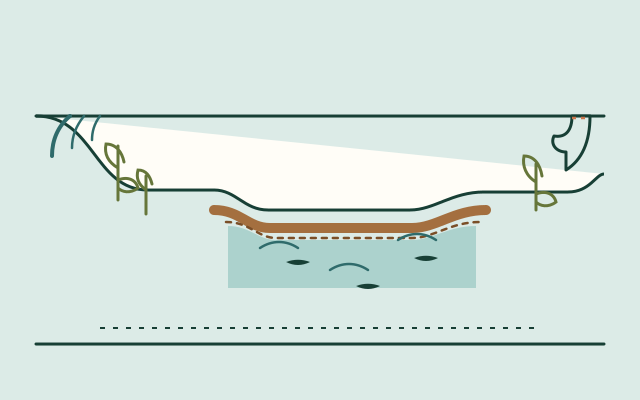
A pond is not a hole you fill with water. It is a small watershed: a basin, a seal, an overflow, a catchment and a community of plants, insects and fish. Build it in the wrong place and it will leak, silt, flood or poison itself. Build it well and it will feed you for decades.
A pond is a watershed
The best pond site is low ground with a reliable supply of clean water and a good layer of clay. Avoid floodplains, steep eroding slopes, contaminated ground, septic drainage, and places where runoff from roads, barns or fields will carry nutrients and pesticides into the water. If the catchment is bare, plant it or divert dirty water around the pond with a vegetated swale.
Check the law before you dig. In many places, building a dam, taking water, storing water or introducing fish requires a permit, and disturbing a watercourse or protected habitat is an offence. Talk to the landowner, the local water authority and the fisheries agency. A pond that is beautiful but illegal is a liability.
Size for your purpose. A pond of 100–500 m² (roughly 10–50 m across) is a manageable small-scale fish pond. Depth matters more than area: 1.5–2.5 m in the centre protects fish from summer overheating and winter freezing, while shallow shelves (20–50 cm) grow plants and invertebrates. A simple rule is that at least a quarter of the pond should be shallow edge.
Design the basin
Shape the basin with gently sloping sides — roughly 1:2 to 1:3 (one metre of depth for every two to three metres of horizontal distance) — so the clay can be compacted and the edges are safe. Leave a shallow shelf around part of the perimeter for reeds and marginal plants, and a deeper zone in the middle for fish to retreat to. Keep the bank above the waterline gently graded and vegetated to filter runoff.
Plan an inflow that does not erode the bank, a sediment trap before the pond if the inflow is silty, and an overflow/spillway that carries excess water safely around the dam, not over it. The spillway must be wide enough for the biggest storm you expect and lined with stone, grass or a stable earth channel. An emergency overflow is not optional; a pond that cannot spill will breach.
If you build an embankment, it needs a compacted clay core keyed into the ground, a wide crest, and a downstream slope that will not slump when saturated. This is small dam engineering; get experienced help for anything more than a low, hand-dug pond.
Build the basin
-
Stake out and strip
Mark the shape with stakes and string. Strip the topsoil and stockpile it for the banks; keep the clay-rich subsoil separate for sealing. Remove roots, stones and any organic matter from the basin.
-
Excavate
Dig with hand tools, a cart and a lot of people. Keep the sides sloping and the bottom level. Save the clay. Move the spoil to the downstream side to form the embankment if you need one, but never block the spillway.
-
Prepare the seal
Scarify the basin floor and sides. If the natural soil is clay-rich, compact it in layers of 15–20 cm to a total of 30–45 cm. Break up clods, remove stones, and add water to bring the clay to a stiff, workable consistency. Compact with a rammer, a roller or many feet.
-
Puddle the clay
“Puddling” means working wet clay until it is dense and plastic, then compacting it into a continuous layer. Work it in overlapping sections, and key the seal into a trench around the top edge so water cannot get behind it. Do not let the clay dry out and crack before filling.
-
Build the overflow
Set the spillway level below the top of the dam. Line it with stone or a grassed channel, and make sure it discharges somewhere that will not erode. Add a simple monk or standpipe outlet if you want to drain the pond; a drain makes management much easier.
-
Finish the banks
Replace topsoil on the banks, sow grass or plant dense native vegetation, and fence the pond from livestock. Leave a shallow exit point and a gently sloping access for wildlife and for anyone who falls in.
-
Fill and test
Fill slowly from clean water. Watch for leaks along the dam and at the edges. A new clay pond may seep a little at first; a steady loss of more than a few centimetres a day needs investigation. Let the water settle and the clay swell for a week or two before stocking.
Water quality
Fish need oxygen, the right temperature and a stable pH. Test the water before stocking. A pH of roughly 6.5–8.5 suits most freshwater fish; very acid or very alkaline water stresses them. Temperature determines which species can live there: cold-water fish such as trout need cool, oxygen-rich water; warm-water fish such as carp and tilapia tolerate warmer, lower-oxygen water.
Oxygen is lowest at dawn and in hot, still weather, especially if the pond is overstocked or full of decaying plants. Avoid adding manure or large amounts of feed to a small pond; the nutrients feed algae, which die, rot and consume oxygen. If fish gasp at the surface in the early morning, you have an oxygen problem: reduce stocking, add clean water, aerate, or remove decaying vegetation.
A simple clarity test is a white disc or a light-coloured stone on a string. If it disappears within 30–50 cm, the water is turbid; that may be silt (harmless in moderation) or algae (a nutrient problem). Green soup is not a healthy pond.
Plant and stock
Let the pond settle and establish plants and invertebrates before adding fish. Marginal plants — reeds, rushes, sedges — stabilise the banks and shelter small fish. Submerged plants oxygenate the water but can spread aggressively; use native species and check local advice. Never introduce invasive plants or fish, and never move fish or water between catchments: that is how disease and invasive species spread.
Choose fish that are native or legally permitted in your area and suited to your water temperature. Local extension services and fisheries agencies can advise on species and permits. Start with a low stocking rate — roughly one fish per 2–5 m² of water surface for a low-input pond — and increase only if the water and the food supply support it. A pond that is overstocked will crash.
| Fish type | Water | Notes |
|---|---|---|
| Carp | Warm, tolerant, 18–28 °C | Hardy and productive; can root up plants; check legality |
| Tilapia | Warm, 22–30 °C | Fast-growing; frost-sensitive; often regulated as non-native |
| Catfish | Warm, tolerant of low oxygen | Bottom feeders; may eat small fish; secure banks against escape |
| Trout | Cold, 10–18 °C, high oxygen | Needs flowing, clean water; not for stagnant warm ponds |
| Native minnows and sunfish | Local conditions | Good for ecology and mosquito control; check permits |
Feed only what the fish eat in a few minutes. Natural food — insects, plankton, duckweed, snails — should supply most of the diet in a low-input pond. Supplemental grain, vegetable scraps or compost can help, but excess feed rots and fouls the water. Keep a feeding log and watch the water, not just the fish.
Manage the pond
Check the spillway before every rainy season. Remove silt and vegetation that block it. Watch for leaks, erosion, algae blooms, dead fish and unusual behaviour. Keep livestock out, control erosion in the catchment, and avoid fertilizers and pesticides near the pond. A pond is a habitat; the more diverse its plants and insects, the more stable it will be.
Harvest fish with a seine net, traps or a line. Take only what you need and return undersized fish. Do not transfer fish between ponds without advice; diseases and parasites travel with them. If you see dead or diseased fish, remove them, stop stocking, and seek local fisheries advice.
In cold climates, keep part of the pond deep enough not to freeze solid, and avoid sealing the surface with ice and snow for long periods; plants need light and fish need oxygen. In hot climates, provide shade and deep water, and expect oxygen problems in still, hot weather.
Safety
Drowning. A pond is a child-magnet and a real hazard. Fence it, supervise children, provide a shallow exit and a reach pole, and never work alone near deep water. Disease. Pond water can carry bacteria, parasites and algae toxins. Wash hands, wear boots, do not drink untreated water, and cook fish thoroughly. Algae. Blue-green algal blooms can be toxic to people and animals; keep livestock and children out and do not use the water for drinking. Mosquitoes. Standing water breeds them; stock fish, keep the water moving, and remove stagnant containers. Dams. A failed embankment can flood homes downstream; get engineering advice and never dam a watercourse without permission.
Sources and further reading
- FAO: Small-scale pond culture — pond construction, stocking and management.
- Wikipedia: Fish pond — types, ecology and management.
- The Wildlife Trusts: How to build a pond — wildlife-friendly design and planting.
- Wikipedia: Aquaculture — farming systems and environmental issues.